
Wayne County Parole Versus Probation
Probation is a Wayne County court sentence served in the community instead of incarceration, or as the court otherwise orders. The local probation office also supervises conditional discharge and reporting supervision. Parole and mandatory supervised release, often shortened to MSR, follow an Illinois prison case. The Illinois Prisoner Review Board sets state parole or MSR conditions, while Illinois Department of Corrections parole staff provide field supervision. Neither status follows automatically from release at Wayne County Jail.
| Supervision | Source | Where to verify |
|---|---|---|
| County probation | Wayne County court order | Judici docket, Circuit Clerk, Wayne Probation |
| Conditional discharge | Local sentencing order | Court file and Wayne Probation |
| Parole or MSR | Illinois prison sentence | IDOC profile, IDOC Parole Division, PRB records |
| Federal supervised release | Federal judgment | PACER and the federal court |
The label matters. Probation is not an early release granted by IDOC. MSR is a period of state control after physical prison exit under many modern determinate sentences. Old-law parole and youthful parole involve specific eligibility and Board review. A Wayne County jail transfer to Graham or Logan Correctional Center starts state custody rather than community supervision.
- Parole
- Community release under terms set through the state parole system in a legally eligible case.
- Mandatory supervised release
- State supervision that follows prison custody under the sentence.
- Probation
- A court-ordered community sentence monitored by the local probation system.
- Discharge
- The end of the sentence and supervision relationship, not merely release from a building.
Verify Wayne County Release Supervision
Begin with the case that placed the person in custody. Wayne County-only cases remain in the sheriff and court record path. An Illinois prison commitment moves the search to IDOC. Use a full legal name, birth date, case number, or IDOC number when available. One matching name is weak evidence.
- Search the Wayne County case through the court docket. Read the disposition and sentencing entries for probation, conditional discharge, reporting supervision, or commitment to IDOC.
- Ask the Circuit Clerk for the controlling unsealed order when the online entry is unclear. A docket note may summarize an order but is not the full filed document.
- For an IDOC commitment, use the IDOC Individual in Custody Search. Compare the IDOC number and identifying details, then read status, location, release fields, and any projected parole date.
- If the profile suggests parole or MSR, call the IDOC parole-issues line for office routing or allowed procedural confirmation. PRB materials can document conditions, eligible parole decisions, or revocation proceedings.
- Record the source and update date. Confirm any urgent or disputed status with the agency that owns the record.
A missing IDOC result is not proof that state supervision never existed. IDOC explains that a person may stop appearing after the sentence and parole are fully discharged. For an older release, request the publicly disclosable admission, release, status, and discharge fields from IDOC or consult the sentencing court. The broader Wayne County released-inmate record path is described on the Wayne County released inmates search.
Wayne County Probation Contacts
Wayne's local court supervision has a named route. The Second Judicial Circuit Wayne directory identifies Jennifer Vaughan and Janaye Vaughan as probation officers at the courthouse. Chief Probation Officer Brian Keck is listed in Mount Vernon. These contacts address local probation, conditional discharge, and reporting supervision. They do not serve as IDOC parole agents and should not be asked to certify MSR.
Wayne County Probation
Jennifer Vaughan and Janaye Vaughan
Wayne County Courthouse
301 E Main Street
Fairfield, IL 62837
Phone: 618-842-7839
Fax: 618-842-6015
Chief Probation Officer Brian Keck
911 Casey Avenue
Mount Vernon, IL
Phone: 618-244-8018
The county describes probation as an alternative to incarceration and states that officers also supervise other court-ordered community terms. Start with the sentencing order before calling. That document identifies the form and duration of supervision, while the office can explain its own reporting process within disclosure limits.
Wayne County Supervision Violations
Conditions are rules attached to release or sentence. A local court order controls Wayne County probation conditions. PRB sets parole and MSR conditions for state cases. Failure to comply may return a probation matter to court or lead to a state violation process, but an allegation is not a final finding.
No official Wayne County absconder or warrant list was found in the reviewed county sources. An absconder is generally someone alleged to have stopped reporting or left supervision without authority. A person may be physically outside custody while a violation or warrant is pending. The reverse can also occur: the person may have been confined again before an online source updates. Use the supervising office and court docket for local probation, and IDOC or PRB for state supervision.
PRB publishes revocation schedules and results, but those lists are not a directory of every person on supervision. A schedule reports a proceeding. The Board's final revocation process uses a three-member panel and majority decision. Read the result before describing the outcome, and do not turn a listed allegation into a conviction.
Note: Registry status and supervision status are separate records; neither substitutes for a current custody check.
Wayne County Parole Hearing Records
The PRB annual en banc calendar gives Board meeting dates. It does not predict a person's release. Current en banc results show published Board action, and the past-parole registry helps with historical grants. Revocation schedules and results address alleged violations after release, not initial eligibility for everyone leaving IDOC.
PRB does not hold discretionary parole hearings for every modern determinate sentence. En banc parole consideration reaches eligible older indeterminate cases and qualifying youthful-parole cases. Most people sentenced under the modern determinate system serve the prison term less lawful credit and then enter MSR. Old-law eligibility under 730 ILCS 5/3-3-3 and youthful review under 730 ILCS 5/5-4.5-115 depend on the offense, sentence, age, and sentencing date.
Published outcomes should be reported in the Board's own terms, such as granted, denied, or deferred. Even a grant is not the physical release timestamp. Planning, conditions, detainers, and agency processing can separate a vote from the day someone leaves prison. PRB records answer a narrow Board question; the IDOC profile and release record answer custody and supervision questions.
The current PRB results page shows how the agency publishes its decisions.
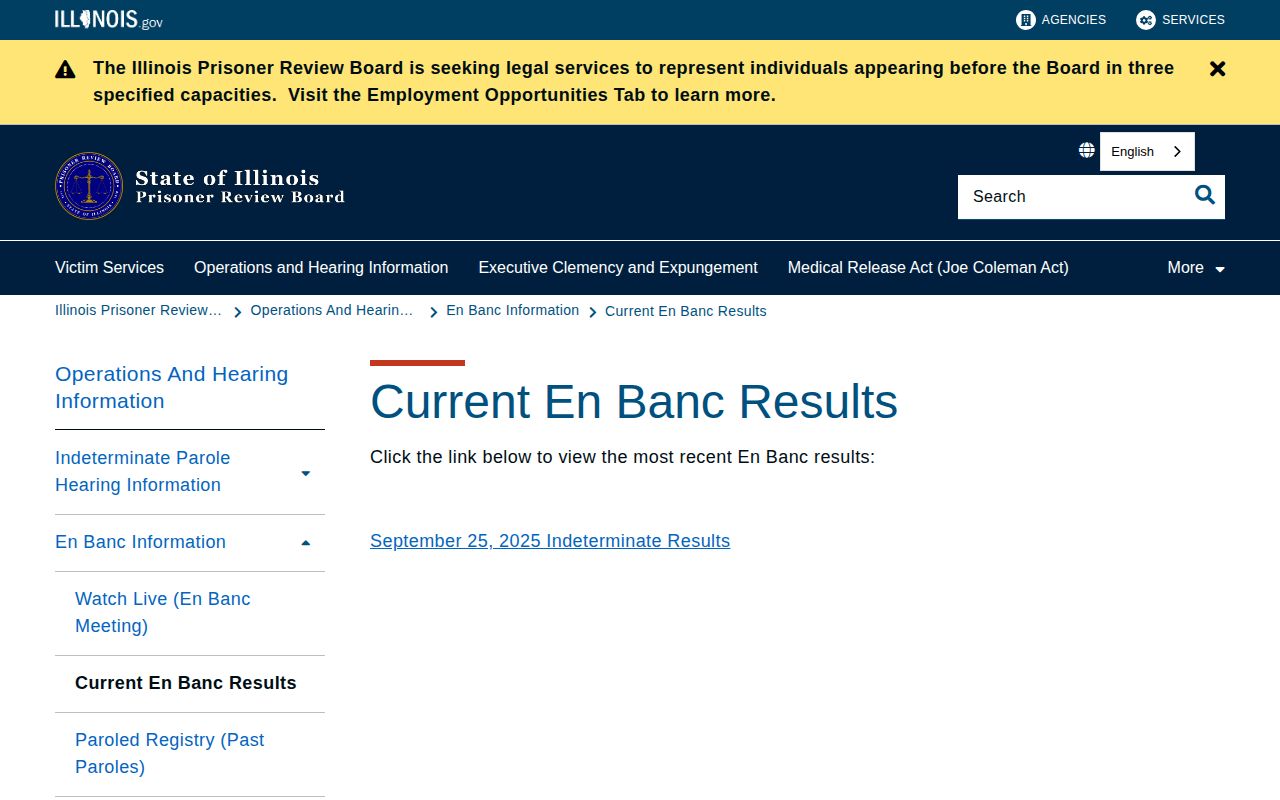
The dated result should be paired with IDOC status because Board action alone does not prove that a Wayne County person completed release.
Which Wayne Supervision Office?
Wayne County's two local officers and the chief probation officer form the distinctive local route for court supervision. This is the Section 19 office distinction: the courthouse team handles probation, conditional discharge, and reporting supervision, while IDOC personnel handle parole and MSR. Calling the wrong system can produce a truthful but irrelevant answer.
For a county case, carry the case number and sentencing date to Wayne Probation or the Circuit Clerk. For a state case, carry the IDOC number to IDOC. PRB is appropriate for Board conditions, eligible parole votes, and revocation records. Its FOIA office handles Board records, not the institutional release log. This division also protects against assuming that every released Wayne County detainee has an assigned officer.
Federal supervised release is a fourth track. It comes from a federal judgment and is resolved through the federal court record, not Wayne Probation or PRB. First classify the case, then contact the matching office.
Wayne County Supervision Discharge
Supervision ends through the controlling system's formal action. A Wayne County probation term ends under the court order and later court record. State parole or MSR ends at discharge under IDOC and PRB authority. Physical release from prison comes earlier in many cases, so an IDOC status showing parole or MSR means the person is outside prison but still under state control.
Final discharge can also make online research harder. IDOC's public search warns that someone may not appear after completing the sentence and parole. For an older Wayne County state case, request narrow IDOC fields such as admission date, actual release date, status, and discharge date. The sentencing court may retain the judgment and docket even when the public corrections profile no longer appears.
A probation completion, prison release, and final discharge are three distinct events. State the event the record actually proves. A court order does not prove the moment the jail door opened, and a PRB vote does not prove release processing finished.
The Wayne court docket can show whether probation was imposed, changed, revoked, or completed through a filed action. The clerk remains the source for an unsealed order when a short online entry lacks detail. For state supervision, PRB records explain Board action while IDOC holds the institutional and field-supervision record. Each office answers only its own part.
A narrow request works best for an older case. Give the full name, IDOC number, case number, and a useful date range. Ask for the precise public admission, release, supervision, or discharge fields rather than an entire file.
Note: Use the latest agency record because supervision can end, change, or return to a hearing process after an older entry was posted.